The Best Bass Flies: Inside Blue Line Fly Co.’s Alabama-Born Revolution
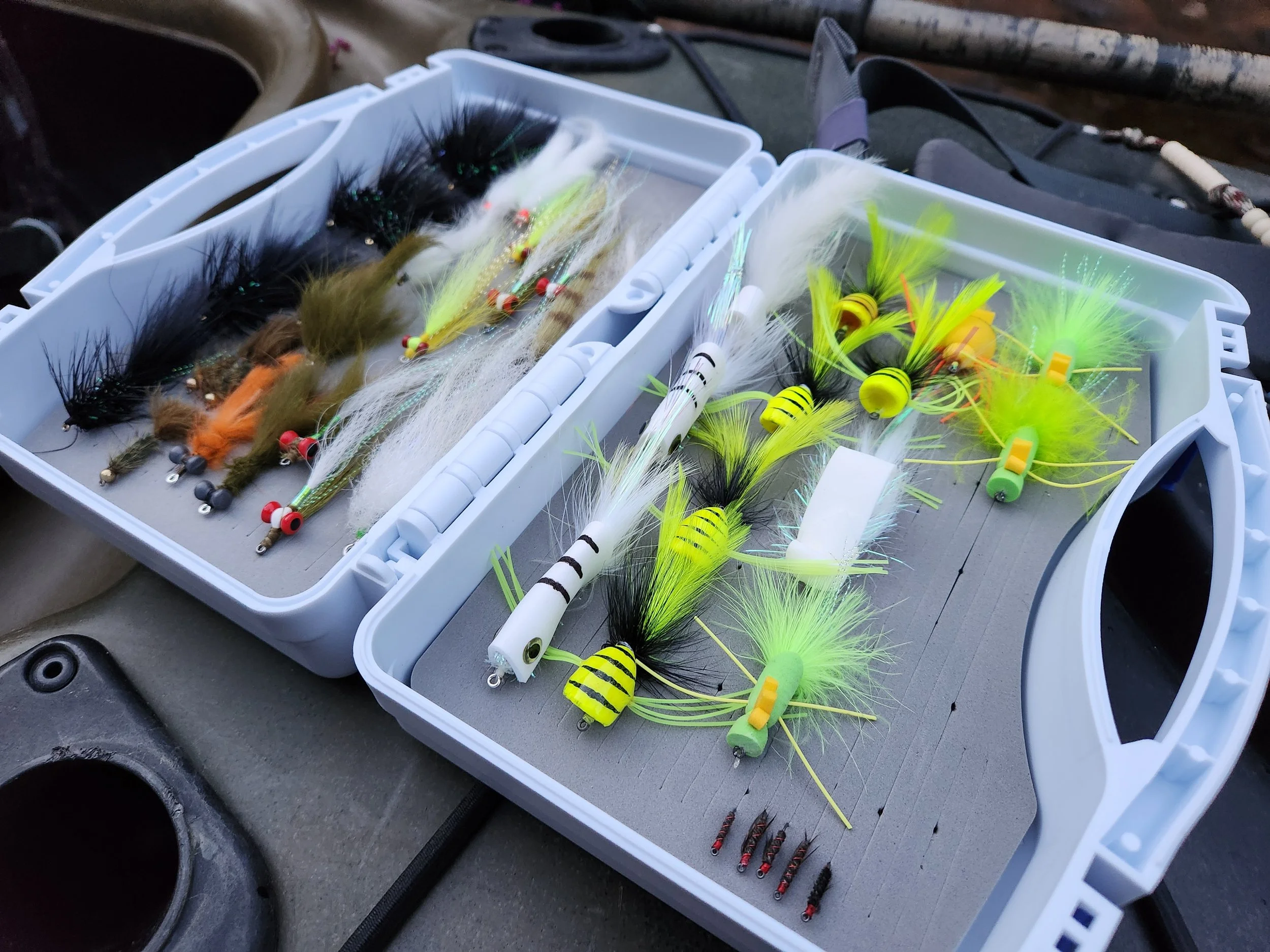
A well-stocked bass fly box should have flies that cover everything from topwater to riverbed.
When most anglers think of fly fishing, they picture cold streams, trout, and western mountain scenery—not bass and southern rivers. But Adam Hudson of Huntsville, Alabama, saw something missing in that picture and decided to change it. As co-founder of Blue Line Fly Co., Hudson turned his lifelong obsession with warmwater fly fishing into a full-blown mission to build better bass flies for anglers who prefer chasing fish that hit hard and live close to home.
A Company Born from Necessity
Hudson started tying flies as a kid on Lake Guntersville, one of Alabama’s most famous bass lakes. “I’d look through the Cabela’s catalog and there’d be nothing for me,” he said. “It was all tiny nymphs and dry flies. I was fishing for bass—big fish that eat big meals—and there was just nothing built for that.” While most of his buddies were chunking crankbaits and soft plastics, Hudson was teaching himself to cast a fly rod on the same ledges and grass lines the power-fishing crowd haunted.
In those early days, most of what he learned came from trial and error. He tied in his parents’ garage using whatever materials he could scrounge—deer hair from local hunters, old craft supplies, bits of marabou from store-bought jigs. “There wasn’t a fly shop within two hours of Huntsville back then,” he said. “If you wanted to fly fish for bass, you were on your own.” His father was a conventional angler who loved chasing largemouths on the Tennessee River, and Adam tagged along, watching closely, then going home to try to recreate those same baits in feather and fur.
Eventually, he met his partner-in-crime, Stephen Johnson—known to everyone as “Hobo Steve.” The nickname stuck after a summer road-trip where Steve, a fellow Huntsville native and outdoors junkie, basically lived out of his truck chasing fish all over the Southeast. The two met in middle school and bonded over fly rods, worn-out gear, and a shared sense that warmwater fly fishing didn’t have a real home. “Steve was the first guy I met who was as obsessed with it as I was,” Hudson said. “We’d sneak out after school and fish the creeks running through town, or load up my old canoe and hit Guntersville until dark.”
By the time they were in their twenties, they had a reputation around North Alabama for showing up anywhere there was fishable water, fly rods in hand. When they weren’t fishing, they were tying late into the night, experimenting with materials to make flies that looked and behaved like the baits local bass actually ate.
So, in 2017, Hudson and Hobo Steve finally turned that obsession into something bigger. They founded Blue Line Fly Co. to fill a gap they’d both felt for years. Their focus was on bass fishing flies—patterns designed from the ground up to perform in southern lakes, ponds, and rivers. From the start, the goal wasn’t to make prettier versions of existing flies, but functional ones that moved right, sank right, and tempted even the most skeptical bass.
Warmwater Science: How Bass Flies Differ
Adam Hudson described a clear design difference between flies made for moving water and those tied for still water. He explained that many of the classic bass fly patterns—like the original Clouser Minnow—were developed for smallmouth bass in rivers, where fast current naturally imparts life and motion to a fly. These flies often use stiff materials like bucktail, which hold their shape and “swim” properly when water pushes through them. In current, that stiffness helps the fly maintain profile and prevent collapse during each strip or drift.
Still water, on the other hand, presents a very different challenge. In lakes and ponds, there’s no flow to animate the fly, so the only movement comes from the angler’s retrieve. Hudson said this means a fly has to create its own motion through design and materials. For that reason, Blue Line uses softer, more supple fibers—things like craft fur, marabou, and long strands of flash—that breathe and undulate even when the fly is barely moving. Their still-water patterns are also tied to balance correctly on the pause, either hovering in place or sinking slowly and horizontally rather than dropping stiff and nose-first.
He used Blue Line’s modified Clouser Minnow as an example. The original, built from stiff bucktail, was perfect for tumbling through riffles and runs in current. But on a calm lake, that same fly would look lifeless once the strip stopped. The Blue Line version incorporates flowing flash and craft fur to keep pulsing between strips, making it effective in ponds or reservoirs where bass have time to inspect their prey.
In short, Hudson’s philosophy is that flies for rivers rely on the water to provide motion, while flies for still water must generate their own movement and realism.
The Best Flies for Bass Fishing
Similarly to many bass anglers, Adam emphasizes that a well-stocked tackle box should include flies that cover the entire water column, since bass will feed throughout it depending on a variety of factors. “If I’m bass fishing,” he said, “I’ve always got a Gurgler, an El Jefe Minnow, and one of our crawfish patterns. That covers everything—surface, mid-column, and bottom.”
The Gurgler, he explained, is one of those flies that never goes out of style. Blue Line’s version borrows from Jack Gartside’s classic saltwater pattern but adds a few warmwater upgrades—rubber legs, long strands of flash, a flashy cactus chenille body, and synthetic craft fur instead of bucktail for the tail. “It’s my favorite topwater fly because it’s alive even when you’re not moving it,” Hudson said. “You can give it one twitch and just let it sit. The legs and flash keep waving in the water, and that drives bass crazy.” He prefers to throw it at dawn or dusk on quiet ponds and calm river eddies, when fish are looking up but wary of big splashes.
The El Jefe Minnow is his workhorse streamer—the fly that bridges the gap between the classic Clouser Minnow and a modern baitfish imitation. Built on heavy hooks with lead dumbbell eyes, it’s designed to get down quickly and maintain a horizontal swimming posture. The body is tied from soft, flowing synthetic fibers that pulse with each strip, giving the illusion of a breathing, panicked baitfish. “It’s meant to look like a shad or small bluegill,” Hudson said. “We wanted a fly that worked just as well in a still lake as it did drifting through current, so it’s all about motion even in slack water.” It’s his go-to choice for covering water and locating fish, especially in the warm months when bass are actively chasing.
Then there’s the Foam-Back Craw. “Every bass box needs a crawfish pattern,” he said. “If you’re not fishing one, you’re leaving fish on the table.” The design keeps a natural defensive posture, with rubber legs and claws that wave even when sitting motionless on the bottom. Dumb bell eyes keep it riding hook-point-up, allowing anglers to crawl it over rock piles, stumps, or brush without snagging. The foam strip back forces the fly to wiggle enticingly at an angle when worked slowly along the bottom. “Most people fish crawfish too fast,” he said. “The key is to let it sit and do its thing. Bass will come over, watch it, and then just inhale it.”
Hudson is also quick to mention the MeeMaw, Blue Line’s signature streamer that’s become a cult favorite among anglers who love chasing smallmouth in rocky, fast-moving water. Built for big eats and heavy hits, the MeeMaw combines bulk, profile, and subtle movement in a way that makes it irresistible to aggressive fish. “There are years I tie one on in spring and never take it off,” Hudson said. “That’s how much confidence I have in that pattern.” For anyone searching for the best flies for bass, he says, the MeeMaw should be near the top of the list.
Smallmouth Bass Flies: Built for the Current
Fishing for smallmouths on the Tennessee River and its tributaries is where Hudson cut his teeth. “Smallmouth love oxygenated water,” he explained. “They’ll hang near current seams, behind rocks, or below shoals where food gets washed through.” Crawfish patterns are key in early spring, but as water warms, baitfish streamers like the MeeMaw start to shine.
The beauty of small bass flies, Hudson says, is their versatility. “You can take a three-inch streamer that’s meant for smallmouth and catch every species of bass in the South with it—spotted, largemouth, Choctaw, you name it. Bass are opportunistic, and the right fly just has to look alive.”
Leaders and Presentation
One thing Hudson emphasizes as much as the fly itself is leader design. “People underestimate how important a leader is,” he said. “You can have a thousand-dollar rod, but if your leader doesn’t transfer energy right, your fly won’t turn over.” Blue Line developed a custom fluorocarbon leader that includes a micro-swivel between sections to let the fly roll naturally in current and prevent leader twist while casting bulky, wind-resistant flies.
The Future of Bass Fly Fishing
Since its start, Blue Line Fly Co. has become a familiar name among warmwater anglers, but Hudson still talks about flies the same way he did when he was a kid tying in his parents’ garage—like a craftsman trying to solve a problem.
When you ask him what keeps him tying, he doesn’t hesitate. “It’s the process,” he said. “You sit down to solve one small problem—how to make something look alive—and then you take it out and see if it works. If it doesn’t, you fix it. That never gets old.”
Blue Line started with that kind of curiosity and still runs on it. The same impulse that drove Hudson to tie his first bass fly on Lake Guntersville is what drives the company now: a belief that warmwater fly fishing deserves its own ideas, not hand-me-downs from trout or saltwater.